North Plains at a Crossroads: Why Balanced Growth Matters Now
- TEAM TRFNP
- Nov 25, 2025
- 3 min read
Updated: 5 days ago
By Russ Sheldon
Short on time? Here are the key things:
City staff warn that current practices are not sustainable and will lead to higher taxes, increased fees, or cuts to services like parks and public safety.
The city has temporarily managed budget gaps through lean services and stopgap funding measures, including using water utility revenues for general operations.
Limited commercial and industrial development means residents carry most of the financial burden for city services.
Of the total property taxes collected, the City of North Plains receives only a small portion ($2.17 of every $15.15 per $1,000 assessed value).
Two primary options were presented: 1. Increase taxes/fees or reduce services, placing more burden on current residents. 2. Pursue planned, balanced growth through Urban Growth Boundary (UGB) expansion, balancing the tax base and brining needed commercial activity to our city.
At a series of town halls in November and December: Residents of North Plains recently heard a sobering message from city staff: the community’s current financial path is increasingly unstable, and without meaningful changes, the city’s ability to provide essential services may be at risk.
At the heart of the issue is a fundamental imbalance. North Plains has long functioned as a “bedroom community,” with roughly 83% of its tax base coming from residential properties and only 17% from businesses. That means local households are shouldering the vast majority of the cost of city services—while the kind of commercial and industrial development that could help share that burden remains limited.

Slides in this article can be found online at City of North Plains.
The problem is compounded by how property taxes are distributed. Of every $15.15 collected per $1,000 of assessed value, the City of North Plains receives just $2.17. State law further restricts how much property tax revenue can grow—capped at 3% annually—while real-world costs for services like public safety, infrastructure, and staffing are rising much faster, often between 4% and 7% each year.
For years, the city has managed this gap by keeping services lean and relying on stopgap measures, including using water utility revenues to help fund general operations. But this approach is not sustainable. As costs continue to outpace revenues, the city faces increasingly difficult choices: raise fees and taxes, or cut services that residents rely on—such as parks, public safety, and community programs.
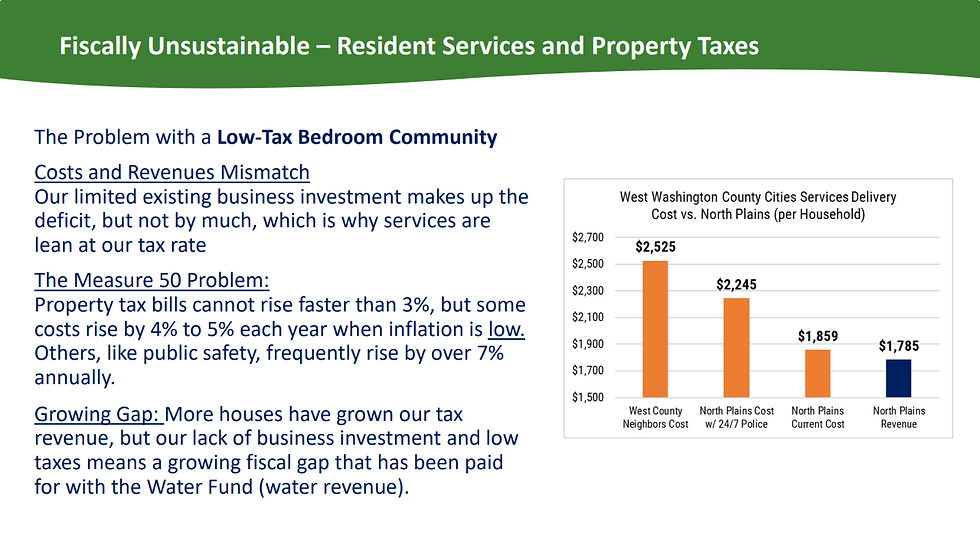
City staff outlined two broad paths forward. The first—raising local option levies, increasing fees, or cutting services—places the burden squarely on current residents. Many neighboring cities have already taken this route, but it comes with real tradeoffs in affordability and quality of life.
The second path is more forward-looking: planned, balanced growth. By expanding the city’s urban growth boundary to include a mix of residential, commercial, and industrial lands, North Plains has an opportunity to rebalance its tax base and create a more sustainable financial future (without including any data centers).
Current planning discussions suggest the need for hundreds of new housing units to meet demand, along with significant acreage for employment lands. Importantly, this isn’t just about growth for growth’s sake—it’s about creating a healthier mix of housing, jobs, and services that can support the city long-term.
Community members involved in recent discussions have emphasized that balanced growth offers a way to protect livability while addressing fiscal realities. A mix of new homes, parks, and business opportunities could help ensure that North Plains remains a vibrant, self-sustaining community—rather than one forced into ongoing service cuts or rising costs for residents alone.
The takeaway is clear: doing nothing is not a neutral option. Without changes, the financial gap will continue to widen. Thoughtful, balanced growth—paired with honest conversations about services and revenue—may be the best path to securing North Plains’ future.
Now is the time for residents to stay informed, get involved, and help shape the decisions that will define the city for decades to come.
The question remains: will City Council take meaningful action?
Stay tuned for the next Bulletin for an update on City Council's approach.